Saturday, October 7, 2017

Rangoonism

In 1991, Aung San Suu Kyi was awarded the Nobel Peace Prize for her non-violent struggle for democracy and human rights. In her acceptance speech, she called for the world to be “FREE OF THE DISPLACED, THE HOMELESS, AND THE HOPELESS.”
Suu Kyi, a student from the Convent of Jesus and Mary School in New Delhi, had graduated in Politics from Lady Shri Ram College. Suu Kyi later obtained a BA in Philosophy, Politics and Economics and an M.A degree in Politics from St Hugh's College, Oxford. She was also later elected as an Honorary Fellow of St Hugh's in 1990.

After graduating, she lived in New York City and worked at the United Nations for three years, primarily on budget matters and shortly thereafter married Michael Vaillancourt Aris, a British historian who wrote and lectured on Bhutanese, Tibetan and Himalayan culture and history. He was the then State Counselor of Myanmar.

Unfortunately, Aris died of prostate cancer on his 53rd birthday in 1999, in Oxford.

After 1989, when his wife was first placed under house arrest, he had seen her only five times, the last of which was for Christmas in 1995, after Suu Kyi had been released for the first time.
.
.
.
Today, Suu Kyi is under attack for not taking a stand against the brutality and wave of terror unleashed on the Rohingya Muslims.
Am not going to details here, but according to UN reports there have been close to 300,000 Rohingya Muslims, who have crossed over to Bangladesh to escape persecution by the MYANMAR ARMY. Furthermore, it is reported that over 1,000 Rohingya people have also been killed.

Oxford Council had bestowed the freedom of the city on her in 1997, when she was being held as a political prisoner by Myanmar’s military junta for her "struggle for democracy."

Well, what I now find funny is that it is the same Oxford Council that is stripping Aung San Suu Kyi, of the Freedom of Oxford over the Rohingya Muslim crisis. The governing body of St Hugh’s college has also decided to remove the painting of the Nobel laureate from its main entrance. According to Beebs, the council leader, Bob Price, had supported the motion, reportedly calling it an “unprecedented step” for the local authority. They believe that the City's reputation has been 'tarnished by honoring those who turn a blind eye to violence.

What I find it even more amusing is that a number of British institutions say they are reviewing or removing honors bestowed on Aung San Suu Kyi during her campaign for democracy.

Little do people realize Beebs has a love-hate relationship with Suu Kyi?

It is claimed that Suu Kyi made an angry 'Muslim' comment after a tense exchange with BBC presenter Mishal Husain
.
Mishal, whom I personally knew as a kid while in the Middle East has blossomed well… Born to an erudite Pakistani Doctor, and an even more charming wife, Shama!

Like the usual story, Tazi Husain and his wife were neighbors in Rawalpindi. They got married and moved to the UK where he specialized to become a Surgeon and later moved on to the Middle East.after getting his FRCS.

Mishal was their progeny and if I remember clearly, she had a brother too. She was there during my time in Middle East, and like all Expat children, she did her schooling in the International School. Little did I realize she would go on to become a News Anchor and that too with Beebs…? All I remember about her was a shy girl with ponytails laughing off at parties with big eyes.

Having said that, I am not taking sides here, Mishal is a good presenter and can stand her ground. Adding to Suu Kyi’s misery, the whole issue was just blown out of proportion.

I wish it was some other presenter who had done this... I sometimes shudder to think, if it was Christianne Amanpour.

Anyway, this should not in anyway deviate from our main issue.

For someone who has spent over 15 years in Prison, I think there is something wrong somewhere… Of course, I could always be wrong.

Besides, I have this habit of mouthing myself off in the wrong places.

Aung San Suu Kyi‘s STORY IS ONE OF COURAGE AND DETERMINATION, ESPECIALLY THE WAY SHE TOOK ON THE MIGHT OF THE MILITARY JUNTA FOR RESTORING DEMOCRACY.

Now, that takes a lot of spunk!

She also spend over 15 years in prison... that takes even more guts!

Although in the 1990 general elections, Suu Ki’s party, the National League for Democracy (NLD), witnessed a resounding victory, the MILITARY JUNTA refused to recognize the results.

The military kept Suu Kyi under house arrest for 15 years. In spite of her captive years, she kept fighting for the restoration of democracy and for ensuring the fundamental rights of the people.

In the 2015 general elections, her party once again achieved a landslide victory. This finally forced the military junta to call Suu Kyi to form the government, and consequently ended 50 years of military rule.

Funnily, she was unable to become President because of a constitutional amendment her father had formulated, which debars citizens married to foreigners from taking the Presidential office. Therefore, she now holds the position of the State Counselor, a position akin to a Prime Minister.

Tell me, Rangoonwala… is there not something fishy?

For someone who studied in India, imbibed its culture, went to the UK, and qualified in multiple specialties and worked in the UN…it just isn’t right (personal opinion, you might say)… Married to a English Historian who specialized in Bhutanese, Tibetan and Himalayan culture and history…

And now being blamed for ethnic cleansing...

Ethnic cleansing is something you associate with Hitler, or Heinrich Himmler, or Joseph Goebbels or in the modern day times… Radovan Karadzic, or the Bosnian Serb military commander, General Ratko Mladic….not some lady who spent 15 years in prison.

There is something wrong somewhere.

Besides, this is not surprising given Myanmar’s history with the Military Junta. It had been in power for over 50 years.

They say that Nawaz Sharif is just a puppet in the hands of the Army, and he virtually has little control in the running of the state. Now that is no state secret. I am not saying that it could be a similar scenario in Myanmar, but it is a possibility, and this needs to be sorted out at the earliest.

Isn’t it strange that a Buddhist country have abandoned the teachings of Gautam Buddha, who advocated non-violence, compassion, and brotherhood?

Now they want to strip her off her Nobel Prize as well.

If Suu Kyi fails to act, she will go down in history as an unworthy recipient of a Nobel Peace Prize. She should heed the advice of fellow Nobel Peace Prize winner, Archbishop Desmond Tutu. In his open letter to her, he said,

“If the political price of your ascension to the highest office is silence, the price is surely too steep… We pray for you to intervene in the escalating crisis and guide your people back towards the path of righteousness.”

IN THE MEANTIME, THE UN SHOULD PRESSURE MYANMAR’S MILITARY JUNTA TO PUT AN END TO THE KILLING AND FIND A SOLUTION TO RESTORE PEACE IN THE REGION.

I think it would be nice if someone traveled to a neighboring country, Malaysia, and interviewed Mahathir Mohammed and the supposed sodomizer Mr. Anwar Ibrahim. The poor bloke has been serving term for close to 19 years, and for what… Sodomy!

Maan, here we are talking about ethnic cleansing and Suu Kyi!

Mahathir has recently stated that he has no objection to Mr. Anwar Ibrahim being Premier and will support him in the coming elections. What a joke, after 18 years Malaysia’s Mahathir plans to support Anwar.

Hoo La… what a Backing (pardon the pun)!

The world has truly become a place of hate.

To quote Bob Geldof in a recent interview…and to think that I once admired this bloke (perhaps it could be senility... am still willing to forgive him for his rant!)

Bob Geldof says Aung San Suu Kyi has become 'one of the great ethnic cleansers'.

I am sick of these leaders. I am sick of Putin. I’m sick of Xi Jinping. I’m sick of Trump. I’m sick of Erdogan. I loathe these people. I despise them. How dare they behave in the manner they behave?

Geldof also took aim at the current problems facing the world and said that the “old traditions have failed us.” “They give us this imbecilic inequality,” he said. “How did we allow it to happen? How is that just? And, how is it human? It is a world without leadership.”

Monay Boba...you tell us!

He closed by urging the young people in attendance to come up with the ideas that would change the world for the better.

Pinne…

Young guys to come up with ideas, so that you can point fingers later.

Nee Poda…

Pappa Baranam Vendappa!

Saturday, September 30, 2017

Where Do You Go To My Lovely When You Are Alone In Your Head

We all live two identities, but are afraid to openly express and live the other identity, because of the social ostracism that we may have to face.

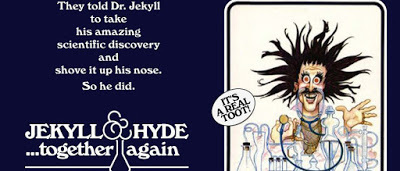
I decided to write this, where I interconnected my Dr. Jekyll identity with my alter ego, Mr. Hyde, and found it rather thought provoking.

People always speak about their forever non-dominating, non-controlling, and non-resistant Dr. Jekyll sides, but never their alter egos. Therefore, I thought it would be unfair if a piece was not written for Mr. Hyde, (pardon me if he resembles any living character, as this was written out of pure Saturday blues, and some excess malted barley water for company!).

Jekyll & Hyde
Jekyll & Hyde Together

Mr. Hyde is a control freak and does not like being laughed at!

But then, control dramas, never work the way that we want.

Even with a child, control tactics will only meet with resistance. You are not running a boot camp, you could be running an organization, perhaps even a country.

Is There A Way Out?


Begin with trusting employees, who by nature, want to do good work. Always be available to guide and provide them advice, if and when necessary.

You have to also realize that it has become increasingly difficult to function with virtual images these days. As a result, psychic communication is increasingly becoming passe.

Hence, most visions end up as hallucinations. As a result, people who end up trying to execute their visions, eventually fail. It is the ability to distinguish the vision from the hallucination that really matters.

This is the reason that people fail to realize, that, it is a thin thread that separates Mr. Hyde with Dr. Jekyll, and one slip could easily end up classifying Jekyll as a Mr. Hyde!

Jekyll And Hyde
An Analysis Of Your Hyde Levels

Now returning to where we started… most of the market today, works on AI (Artificial Intelligence), which incidentally works on a funny code. That is, a 1, 2, and a 1, 2, 0 standards. More like a binary code in computer jargon.

For somebody not quick on the uptake, and not familiar with the binary code, you will surely be lost!

Is There an Alternate Way?


NLP or neuro-linguistic-programming should be a lot more organized… as few seem to understand it.

Now did someone say something?

Yes, I heard it… you said something!

Must make an appointment with my psychiatrist!

So, how do we solve this?

Now let us create A as the demand, and B as the supply, and C as the constant, so that whenever there is a break in communication we can always move over to the other side. In other words, you have to know both sides…

Oops, ego beckons…. Let us bathe in it… or else one cannot control the neurotic… I mean Hyde!

Where Does The Male And Female Elements Fit In Such A Process?


One of the hottest ideas in today’s minds, or let me put that it in a better way “the current market mindset” is driven by female masturbation…

Personally, I have nothing against it, nor in anybody pleasuring herself, it is just the fact that I don’t own a vibrator store, or else, I could have at least made a killing out of such a market mindset.

Leaving bad investments and dreams aside, if this mindset continues we can definitely expect many ideas to “flow.”

The most interesting and humorous aspect is that the female community is going at it with no “hang-ups” let alone, any qualms in discussing it. It is just another “finger in the pie” aspect. Worst case – fingers in different pies, at least from their point of view.

They do not even need a Gynecologist these days.

Does this mindset extend to the male species, some of you may ask.

Most definitely, the male has been at it for centuries.

Unfortunately, this turn of mindset has been quite shocking for the male member. He for one, has never thought of competition from the opposite species. In a way, the male member has lost its usual regalia and position, and as a result needs some coaxing to even to get in to his previous position, let alone get going…

The jamming is so much that he misinterprets any ideas and as a result, he ends up in the manhole… this for sure is not the right path to ecstasy.

It’s funny that all this while, the male species have had their fingers in any hole they could find and suddenly, they are out of a job and landing in their own.

Absolutely a drastic thought…

We need a change…

They are even making movies about it in India.

“Toilet Ek Prem Katha!” (Toilet, A Love Story)

Now, Where Do You Go My Lovely When You Are Alone In Your Bed?


After the glitter fades, beneath the leather and lace, we are just scared, trying to learn how to love, amid the gaudy after images. And, when darkness falls, and we crouch naked and are alone in our slack, aging bodies, snuffling with fear, and snarling at the grinning phantasms of our toilet-flushed dreams, with a fistful of pills to keep us company.

For starters, we could try and think the opposite, with their members and the male manhole.
Masturbation apart, let us take on another issue – to use our ability to laugh.

It is the most powerful thing that we have been given, and it is our greatest gift, especially if we can “laugh at ourselves.”

When you make fun of what frightens you, you get a mastery over it and gain control.
So go ahead, act silly.

When you throw your head back and laugh, you are not thinking of anything else.
So, here is your anecdote for the day…

It is a beautiful spring day and a man and his wife are at the zoo. She has on a close-fitting, low-cut, summer dress with spaghetti straps. As they walk through the ape exhibit, and pass in front of a very large gorilla, it goes agape.

He jumps up on the bars, he grunts, he pounds his chest. He is obviously excited at the sight of the young lady in the sundress. The husband, noticing the ape’s excitement, suggests that his wife tease the ape a bit.

The husband suggests that she pucker her lips and wiggle her bottom. She does, and the ape gets even more excited, making noises that would wake the dead.

Then her husband suggests that she let one of the straps of her dress slips down. She does, and Mr. Gorilla nearly tears down the bars.

Her husband suggests she lift her dress up her thighs and she does. This drives Mr. Gorilla absolutely nuts.

Then quickly the husband grabs his wife, rips open the door to the cage, flings her inside with the Gorilla, slams the door shut and gleefully rubbing his hands together says.

Now, tell him you have a HEADACHE!

Laughter is the best thing you can do for your health.

“The old saying that ‘laughter is the best medicine,’ definitely appears to be true when it comes to protecting your heart,” says Michael Miller, M.D., director of the Center for Preventive Cardiology at the University of Maryland Medical Center and associate professor of medicine at the University Of Maryland School Of Medicine. It not only protects your heart, but also prevents a stroke!

So, go ahead and laugh at yourself, and appreciate the importance of laughter.

After the glitter fades, beneath the leather and lace, we are just scared, trying to learn how to love, amid the gaudy after images. And when darkness falls, and we crouch naked and are alone in our slack, aging bodies, snuffling with fear, and snarling at the grinning phantasms of our toilet-flushed dreams, with a fistful of pills to keep us company.

For starters, we could try and think the opposite... with their members and the male manhole...

Masturbation apart, let us take on another issue - to use our ability to laugh.

It is the most powerful thing that we have been given, and it is our greatest gift, especially if we can "laugh at ourselves."

When you make fun of what frightens you, you get a mastery over it and gain control.

So go ahead, act silly.

When you throw your head back and laugh, you are not thinking of anything else.

So, here is an anecdote for the day...

It is a beautiful spring day and a man and his wife are at the zoo. She has on a close-fitting, low-cut, summer dress with spaghetti straps. As they walk through the ape exhibit, and pass in front of a very large gorilla, it goes ape.

He jumps up on the bars, he grunts, he pounds his chest. He is obviously excited at the sight of the young lady in the sundress. The husband, noticing the ape’s excitement, suggests that his wife tease the ape.

The husband suggests that she pucker her lips and wiggle her bottom.... She does, and the ape gets even more excited, making noises that would wake the dead...

Then her husband suggests that she let one of the straps of her dress slips down... She does and Mr. Gorilla is about to tear down the bars...

Her husband suggests she lift her dress up her thighs and she does. This about drives Mr. Gorilla crazy...

Then quickly the husband grabs his wife, rips open the door to the cage, flings her inside with the Gorilla, slams the door shut and gleefully rubbing his hands together says...

Now, tell him you have a HEADACHE!

Laughter is the best thing you can do for your health.

"The old saying that 'laughter is the best medicine,' definitely appears to be true when it comes to protecting your heart," says Michael Miller, M.D., director of the Center for Preventive Cardiology at the University of Maryland Medical Center and associate professor of medicine at the University Of Maryland School Of Medicine.

If not only protects your heart, but also prevents a stroke!

So, go ahead and laugh at yourself and just appreciate the importance of laughter...

Jekyll And Hyde
You Can Run But You Can’t Hyde

(With due apologies to the late Peter Sarstedt)…

Where Do You Go To My Lovely When You Are Alone In Your Bed… I Know The Thoughts That Surrounds You, Cause I Can Look Inside Your Head!


Friday, September 29, 2017

I Read Playboy For The Articles

As a semi-struggling writer, I would just like to say a few words about Hefner, the quintessential Playboy…

Let's also take a moment to remember that "I read Playboy for the articles" is more than just a joke.

Way back when I was up to the nose in puberty and the Internet didn't exist for us commoners, when I did happen to come across a 'Playboy', I'd ... err ... peruse the pictures quite a bit… After a while, the reading addict I am, would inevitably get caught up in one of the articles and start reading it. And then all of them. To be honest, I was surprised at how well written some of those were.

That said, I've never bought a 'Playboy' or similar magazine as an adult… (Much as some college friends might disagree!)

The Playboy's literary aspect was vast... most readers would agree with me on this aspect.

Mentioned below are some of the many such pieces that further substantiates this, and just does not view Playboy with the brand marketing it is associated with.


  Ayn Rand's Playboy Interview


 Stephen King publishes poem in Playboy


Now to highlight the literary aspect… (I just copied this from the net about a ’68 Playboy issue) …

It's December 1968 and you grab a mag at the local newsstand. (picture given below)

The table of contents includes the following... A quartet of short stories by Alberto Moravia... a symposium on creativity with contributions from Truman Capote, Lawrence Durrell, James T. Farrell, Allen Ginsberg, Le Roi Jones, Arthur Miller, Henry Miller, Norman Podhoretz, Georges Simenon, Isaac Bashevis Singer, William Styron and John Updike.. Humor pieces from Jean Shepherd and Robert Morley… An article on pacifism in America by Norman Thomas… A piece on how machines will change our lives by Arthur C. Clarke…An essay on "the overheated image" by Marshall McLuhan… Contributions from Eric Hoffer and Alan Watts…An article in defense of academic irresponsibility by Leslie Fiedler…A memoir of Hemingway by his son Patrick… Eldridge Cleaver interviewed by Nat Hentoff…A travel piece by the espionage novelist Len Deighton…And the first English translation of a poem by Goethe.


Yes, folks, that was Playboy!

And lest you think that issue was a fluke, an overstuffed Christmas goodie, the ad for the January 1969 issue promises a story from P.G. Wodehouse, an article by Supreme Court Justice William O. Douglas, fiction from Robert Coover and Sean O'Faolain, and a never before published tale by Lytton Strachey.

Phew!

Now back to Hef and Playboy...


 1973 Playmate of The Year party at the Playboy Mansion with Hefner


Playboy's pages became cherished terrain for writers who wanted to experiment and stretch their boundaries. Playboy "was bold and frank… Contributors over the years have included a galaxy of stars, among them Kurt Vonnegut, Jack Kerouac, Margaret Atwood, Shel Silverstein, Norman Mailer, Jimmy Breslin and Joyce Carol Oates.

Sure, the reason most of us started reading Playboy was for the girls!

Still, Playboy did appeal to a much broader audience than its advertising and brand identity suggested “If you take nudity out, what’s left?”

Over the years, to be fair, Playboy faced the same issues that porn companies have faced for years. How do you make money in a landscape overflowing with free pornography?

Adult-industry experts lament at the porn glut and wonder how to stay alive. Playboy finds itself now just as disposable as the beautiful women who have worked for it as models over the years.

Hugh Hefner, once told Playmates at a reunion: "Without you, I'd be the publisher of a literary magazine."

Playboy Editorial Board 1970


And then what is any piece nowadays without the mention of the Big T!


 Donald Trump and 'Playboy': A lengthy history


People may never be a fan of Hugh Hefner, but I will say his publication has and had more intellectual merit than many realize.

Of course, when buying one and checking out, remember to ask for a brown paper bag!

Saturday, December 31, 2016

Sociopaths, Narcissists and Empaths

The misconception that sociopaths and narcissists are smarter than empaths is wrong!

To many people’s surprise, empaths are intellectually superior to sociopaths and narcissists.

Empaths are grounded in reality, capable of abstract thought, and they are creative.

Narcissists and sociopaths lack all three of these traits. Empaths have the intellect and the creativity to manipulate and even exploit the narcissist 1000 times worse than they could ever imagine. Just because targets don’t exploit does not mean they can’t, or that they couldn’t, do an even better job than the sociopath.


Being a shallow user is its own punishment. As we see in many politicians, they might achieve power and wealth while being narcissistic and sociopathic, but at what cost? Constant need for approval, multiple failed relationships, and being surrounded by sycophants rather than true friends. Having empathy is smart and it pays on a deeper level.

On a lighter note…. there is no need to control or dominate… nothing can overcome a non-resistant person – this would only surprise the sociopaths and narcissists… but they rarely notice… because they are too busy admiring themselves!

Wednesday, May 20, 2015

The God of Small Things - Ammu’s Dream and Details of Death

Was just leafing through Roy's novel once again the other day, and it appeared more meaningful now, rather than the first time...

I know that only reading it once is not nearly enough to grasp the importance and understanding of everything. I would like to discuss two things that really stuck out to me.


Ammu’s Dream

The chapter highlights Ammu and the relationship between her body and her cremation. Roy delves further into analyzing Ammu’s body during Chapter 11. She dreams of the one armed man (Velutha) that she cannot touch. The ultimate struggle in her dream is that “If he touched her he couldn’t talk to her, if he loved her he couldn’t leave; if he spoke he couldn’t listen, if he fought he couldn’t win” (p. 207).  The first problem with their desire was that they could not touch each other. This brings in the obvious caste difference because of Velutha being a dalit. The other aspects of their relationship presented in this quote (love, communication, future success of the relationship) are not given much attention. The physical barrier is too strong to overcome. Also at this point in the novel, the most interaction that we have seen between Ammu and Velutha was eye connect and unvoiced desire.

Ammu’s dream is interrupted by the twins. But they are afraid to directly wake her up because “she says you should never wake dreaming people suddenly…she says they could easily have a Heart Attack” (p. 207). She is dreaming about her physical reaction to Velutha while the twins are concerned about her physical reaction to them. I believe that Roy brought extra attention to Heart Attack because of it would be a physical death to her being as well as a romantic death to her dream of Velutha.  *Pappachi died of a heart attack (p. 49).

The twin’s reaction to their mother’s dream is also important. Estha thought that she looked like she was dying but Rahel was certain that she was having an “afternoon-mare” (p. 208).  To her children, she appeared sad and distressed during her dream even though she felt happy.  I felt like this was an accurate description of pending relationship with Velutha. Love should bring happiness but between Velutha and Ammu it is bound to bring death and sadness.

The question is that after the dream she recognizes that the one armed man, Velutha, was “the God of Loss, the God of Small Things” (p. 210). Why are loss and Ammu and Velutha’s affair classified as a “small things” in this novel?

The details of the deaths in the novel

All of the deaths in this novel involved destruction or dis-figuration of the body. As I previously noted, Pappachi died of a heart attack. The physical demolition surrounding his death was that which he inflicted on other bodies, not his own. He beat Mammachi and when he could no longer do that he destroyed his favorite rocking chair. As the novel continues, the family does not escape the trend of deadly destruction that he started. We have already spent a decent amount of time discussing Ammu’s death and cremation. Not only is her body decimated but so is her capability to invoke desire and lust. Sins of the body paid for by erasing her body.

But in Chapter 13, we finally learn the details of Sophie Mol’s death, the most central one to the narrative. When her body was laid out, “it was obvious that she was dead” and did not look like her living self (p. 238).  She had weeds in her hair, her face had been nibbled on by the fish, and she was wrinkled. She was completely disfigured. Her drowning had transformed her into a “spongy mermaid who had forgotten how to swim” (p. 238). The body that was hers now belonged to death.

I don't know about you, but if one had to pick the character that most people dislike in the novel, it would probably be Baby Kochamma. She's selfish, self-centered, snippy, and just downright mean. Still, a novel without an antagonist would be like chocolate chip cookies without the milk, or karaoke without a Kelly Clarkson song: it just doesn't seem to work as well if that key piece is missing. As much as we want to tell Baby Kochamma to get over herself and take a hike, we actually need her. In a novel that covers such a big stretch of time, Baby Kochamma's history is the longest of any other character.

But then, who is Baby Kochamma?


First, a little back-story: Baby Kochamma is not a baby, and her last name is not really Kochamma. We never find out exactly why she takes on the name Baby, but it's how everyone knows her. Her real name is Navomi Ipe, and Kochamma is just a title of respect and honor for a woman. Baby Kochamma's acts of getting Velutha and Ammu in trouble and manipulating Estha and Rahel after Sophie Mol's death are key moments that show us just how insecure she is when it comes to social status. Here's a woman who knows exactly what she's doing: she's a total snake in the grass, even if she acts like she truly cares about everyone else.

The Baby Kochamma of 1993 lives a pretty simple life in comparison. There's not really anyone left to manipulate. Ammu and Mammachi are both dead, and Chacko has moved to Canada. She's totally addicted to satellite TV, and as a result she's let the house fall to pieces around her. She sits around wearing all of Mammachi's old jewelry as though she's playing dress-up. Rahel observes that it's like Baby Kochamma is "living her life backwards" (1.136). All in all, Baby Kochamma is hard to like, but all in all, she's a complex and interesting character.

Who is Estha ?

Estha, short for Esthappen Yako, is the other half of our dynamic twin duo. He was born eighteen minutes before his twin, Rahel, which is sort of fitting since in many ways he seems like he's her older brother. Even as a child, Estha is almost painfully earnest and sincere. He loves his mother and Velutha, and he's protective of Rahel. Because he's such a sweet boy, it can be hard to watch what happens to him throughout the novel.

First, a look at Estha in 1969. He is a seven-year-old who loves Elvis Presley (he wears his hair in a puffed-up style to imitate him) and has a very childlike view of the world. He loves The Sound of Music, and one of the book's most heartwarming moments is when he sings so happily from the top of his lungs that he has to leave the movie theater.

fast forwarding... Estha's reunion with Rahel brings back a number of painful memories that up until this moment he has kept packed away. Estha and Rahel end up delving through many memories of their childhood, and he notices how much she looks like their mother. At the end of the novel, he and Rahel have sex – though it happens so quickly and quietly that we barely notice it – and grieve together for all that they've lost...

Who is Reverend E. John Ipe/ Punnyan Kunju ?

He's Baby Kochamma and Pappachi's father. He was a well-regarded priest in the Mar Thoma Church. He became known as Punnyan Kunju (Little Blessed One) after the Patriarch of Antioch, who is the head of the Syrian Christian Church, personally blessed him. His portrait hangs in the Ayemenem House.

Who is Urumban ?

Urumban is not a real person. He is the fake "twin" that Velutha makes up when Rahel claims she saw him in the Communist march.

Does the details of these deaths classify as small things? Why does Roy primarily use tragic and non-normative deaths?

We know Ammu best as Estha and Rahel's mother, but it's important to look at her early life when we examine her character. Ammu isn't just a mom; she's also Pappachi and Mammachi's daughter and Chacko's younger sister. Through a number of flashbacks in the novel, we get a good sense of how her past helped shape who she is as an adult.

While Chacko, as the son of the family, is proudly sent off to school and eventually to Oxford to study as a Rhodes Scholar, Ammu doesn't get the same kind of treatment. In fact, it seems like she doesn't have all that many options. Life at her parents' house is tough. Pappachi is kind of a drunk jerk, terrorizing Mammachi and Ammu. Feeling like there's nothing left for her in Ayemenem but to wait around for a husband, Ammu gets permission to go to Calcutta for a summer. She meets and marries Baba, which turns out to be a bad choice.

Ammu divorces Baba and moves back to Ayemenem when the twins are toddlers. Ammu is both a strict and loving mother. What's interesting about her is her resistance to social norms. She doesn't feel like she needs to be ashamed of her divorce. Instead, she feels like she wasted her best years. This quality sets her apart from the other women of the household, who are totally preoccupied with looking better than others in society.

Ammu doesn't think too much of social rank. In fact, she's kind of proud that Velutha was spotted at the communist march, figuring that they both find society's norms oppressive and wrong. This doesn't mean Ammu doesn't care about appearances altogether; she wants her kids to behave well so that everyone can see that a woman on her own can be both independent and a good mother.

Ammu's affair with Velutha is a great escape for her, and we can tell that she has really strong feelings for him, even though she knows their love can never be public. In a way, it's their love that brings about both of their downfalls. Baby Kochamma wouldn't have had to make up stories about Velutha to the police if they hadn't had an affair. Ammu's life after Velutha's death is unimaginably bad. She's lost the only man she ever loved, and she's separated from her kids. She dies alone, likely of tuberculosis, in a dirty hotel room. Still, when she is cremated, Rahel doesn't remember her as the disgusting, hacking, slightly loony woman that she ultimately becomes.

Summarizing..

  • Ammu has kind of a rough upbringing.
  • Pappachi runs Ammu and Mammachi out of the house from time to time.
  • One night, he tears up her rubber boots, her most prized possession.
  • Ammu's parents don't think it's necessary to send a woman to college, so she spends her young adulthood living at home and waiting for marriage proposals.
  • One summer, Ammu's parents allow her to move to Calcutta. She meets Baba, who proposes to her five days after they meet. She accepts.
  • Ammu gives birth to Estha and Rahel in 1962.
  • When the twins are 2 years old, Baba loses his job. He tells Ammu he can keep his job if she agrees to sleep with his boss. He punches her when she says no. After this happens a few times, she takes the kids and moves back to Ayemenem.
  • Ammu gets mad at the twins for misbehaving when Sophie Mol comes to visit. She thinks they make a bad first impression.
  • Ammu sees Rahel run off to talk to Velutha.
  • When Margaret Kochamma makes an ignorant comment about the local culture, Ammu gets angry and storms off.
  • Ammu falls asleep and has a dream about a man she calls "The God of Small Things" (actually Velutha).
  • That night, Ammu goes out for a walk in the dark. She encounters Velutha, and they make love.
  • Ammu and Velutha meet every night for the next thirteen nights.
  • After Vellya Paapen rats Velutha and Ammu out, Baby Kochamma locks Ammu in her bedroom.
  • Ammu yells through the door at Estha and Rahel that it's their fault she's locked in.
  • After Sophie Mol's funeral, Ammu goes to see Inspector Thomas Mathew to clear Velutha's name. He tells Ammu that Velutha is already dead.
  • Ammu is forced to leave Ayemenem. She becomes severely ill.
  • Ammu dies alone in a hotel room. Chacko and Rahel take her to be cremated.

Basically... Ammu is remembered as lovely and, most importantly, loving....

Quotes from Arundhati Roy...The God of Small Things....

“Perhaps it's true that things can change in a day. That a few dozen hours can affect the outcome of whole lifetimes. And that when they do, those few dozen hours, like the salvaged remains of a burned house---the charred clock, the singed photograph, the scorched furniture---must be resurrected from the ruins and examined. Preserved. Accounted for. Little events, ordinary things, smashed and reconstituted. Imbued with new meaning. Suddenly they become the bleached bones of a story.”

“Ammu said that human beings were creatures of habit, and it was amazing the kind of things one could get used to.” Besides, careless words make people love you a little less.”

The trouble with families is that like invidious doctors, they know just where it hurts.......

Sunday, March 15, 2015

Its Time We Stopped Hurting Each Other And Joined The Fun

Our deepest fear is not that we are inadequate. Our deepest fear is that we are powerful beyond measure. It is our light, not our darkness that most frightens us. We ask ourselves, Who am I to be brilliant, gorgeous, talented, fabulous? Actually, who are you not to be? ... As we let our own light shine, we unconsciously give other people permission to do the same. As we are liberated from our own fear, our presence automatically liberates others…Isn’t it time we stopped hurting each other and joined the fun…

Monday, March 2, 2015

Is Hell Exothermic Or Endothermic


The following is an actual question given on a University of Arizona chemistry midterm, and an actual answer turned in by a student.

The answer by one student was so 'profound' that the professor shared it with colleagues, via the Internet, which is, of course, why we now have the pleasure of enjoying it as well.

Bonus Question: Is Hell exothermic (gives off heat) or endothermic (absorbs heat)?

Most of the students wrote proofs of their beliefs using Boyle's Law (gas cools when it expands and heats when it is compressed) or some variant.


One student, however, wrote the following:

First, we need to know how the mass of Hell is changing in time. So we need to know the rate at which souls are moving into Hell and the rate at which they are leaving, which is unlikely. I think that we can safely assume that once a soul gets to Hell, it will not leave. Therefore, no souls are leaving. As for how many souls are entering Hell, let's look at the different religions that exist in the world today.

Most of these religions state that if you are not a member of their religion, you will go to Hell. Since there is more than one of these religions and since people do not belong to more than one religion, we can project that all souls go to Hell.. With birth and death rates as they are, we can expect the number of souls in Hell to increase exponentially. Now, we look at the rate of change of the volume in Hell because Boyle's Law states that in order for the temperature and pressure in Hell to stay the same, the volume of Hell has to expand proportionately as souls are added.

This gives two possibilities:

1. If Hell is expanding at a slower rate than the rate at which souls enter Hell, then the temperature and pressure in Hell will increase until all Hell breaks loose.

2. If Hell is expanding at a rate faster than the increase of souls in Hell, then the temperature and pressure will drop until Hell freezes over.

So which is it?

If we accept the postulate given to me by Teresa during my Freshman year that, 'It will be a cold day in Hell before I sleep with you,' and take into account the fact that I slept with her last night, then number two must be true, and thus I am sure that Hell is exothermic and has already frozen over. The corollary of this theory is that since Hell has frozen over,it follows that it is not accepting any more souls and is therefore, extinct.... ...leaving only Heaven, thereby proving the existence of a divine being which explains why, last night, Teresa kept shouting 'Oh my God.'

THIS STUDENT RECEIVED AN A+

Saturday, February 28, 2015

Love - Start In The Right Direction


What is the secret of a healthy relationship?

A good relationship first begins with YOU.

This works more efficiently when two partners are focused on a goal of keeping their relationship better than ever before.


A lot of relationships have begun so well only to end in disaster. Ever wonder why this happened?

This is mainly because, couples have the tendency to take each other for granted and as a result have become more negligent of each other over the years and months they have been together. This is not how a relationship should progress. In a way as the relationship grows old, it should be viewed in a mature perspective. In other relationships it is not correct to say that relationships grow old, but it should be said “as the relationship matures”.

In most cases, love that has the hottest beginning has the coolest end. In other words, love does not develop over time.

While it is true that there can be a love at first sight, it depends on the partners how to maintain and sustain that love they have felt from the start.

It is important that partners work together in achieving their goal of making the relationship works for them. It is definitely a combined effort and a shared endeavor. Part of every great relationship is setting common goals, then figuring out a way to work together to accomplish these goals. This gives couples a sense of purpose and direction. It also teaches couples how to work together, making their relationship stronger and more rewarding.

This takes a great deal of focus, commitment, and compromise, but the rewards are well worth the effort. Actually, this concept is not limited to only relationships, but applies to other aspects of life such as work and career.

Remember, when you really love yourself, you cannot help wanting to give some of your love away. You must learn to be alone and happy before you can be together with someone else and still be happy. Your happiness always depends upon how you feel when you are alone.

So, when you want a great love partner, become a great love partner. Sharing love with someone must only and always begin with YOU


Friday, February 20, 2015

Thursday, February 19, 2015

Tapping Into Your Subconscious Mind


For years, I have been absolutely fascinated with the power of the subconscious mind.

Its power have made the sick healthy, the poor wealthy, and the sad happy. Those who understand and apply the methods for using the subconscious mind find themselves bathed in more abundance and joy than they could have ever imagined.

Given below are two powerful tips for harnessing and applying your subconscious mind power, to help you achieve far greater success than you have ever dreamed.

As you might already be aware of, the subconscious mind is the seat of all memory, fears, phobias, behavioral patterns, habits, beliefs, and expectations. An astonishingly true fact is that only 2-4% of our day is controlled by our conscious mind, and the other 96-98% is all done by the subconscious. 96% of all your decisions, actions, thoughts, and feelings are all done automatically, unconsciously by your subconscious mind.

It is amazing to think how much our subconscious mind does for us. It beats our heart, digests our food, and breathes for us all without any conscious effort. With all of the amazing things it does, our subconscious doesn’t always do everything we want it to. Many people have realized that they have several bad habits of doing and thinking, and understand that in order to grow and prosper, those habits must be changed. But here is in the problem most people face. How do you change the subconscious to promote success in all areas of life?

The answer is simple.

You must harness the power of your subconscious mind. The first technique in order to do that is called suggestion. A suggestion is a passive statement given to the subconscious to either accept or reject. Hypnotists use the power of suggestibility to promote changes in their subjects.

When a person is in a deeply relaxed state, their conscious mind is out of the way, and the gateway to the powers of subconscious is open. This is where true changes happen. In order to suggest the subconscious to change, the body and mind must be completely relaxed. A person must first have a reason to change, and accept the new suggestion. Then the suggestion for change may be given with intense emotion and desire so that the suggestion is firmly accepted.

The next subconscious mind tip is repetition. If you are suggesting your subconscious to accept the idea of wealth in your life, using repetition can help firmly implant that idea quicker and easier. Our reptilian brain is highly receptive to ritual and repetition. Repetition of an affirmation, or suggestion, such as “I am wealthy and successful” helps firmly implant the idea deeply into the subconscious mind. Over long periods of repetition, the suggestion will reshape thinking patterns, habits, and deeply held beliefs. The entire neuronal structure of your brain will begin change in order to promote the new idea of wealth and success. And once the idea is finally accepted without doubt or question, new worlds of possibilities begin to arise.

Repetition is the tool of suggestion – Repeat an affirmation for change in a deeply relaxed state – Repeat on regular intervals to help the reptilian brain accept the suggestion.

These two subconscious mind control tips can help you clear mental and emotional blockages in your life that are withholding your from your full potential. The power of suggestion to the subconscious mind, combined with ritualistic repetition is the ultimate key to unlocking your mind, and achieving what you desire.


Tuesday, February 17, 2015

Thought For The Day

It is believed that with the blocking of one senses, you are able to open the other areas of senses.

Just imagine, if you are floating in water, just like a cork in a soundproof, dark room, where the body and the head cannot figure out your senses………

The chances are it will open avenues to other areas of the senses which we never knew that we possessed.

Perhaps the sixth sense or the seventh ?

The movie "Altered States" starring William Hurt further emphasizes this theory.

He floats in a isolation tank on water to experience this unique experience. The  movie is pretty good, although it is  sci-fi in nature and is also kind of scary at some points.

In the below clip, the snake and the woman both represent one and the same thing, "Carnal lustful desires" or earthly desires. Besides, after the loud and crazy joyfulness or "sex" is over,  you are nothing, but dust in the wind. You are left with absolutely nothing, because this whole physical human experience is based around sex and wasting our energy on things that never last...


And for these who hate the ending - i am sorry to tell, but its true, all you need is love...

Must try it one of these days – it can open answers to many a question that have been lying unanswered for years


Thursday, February 12, 2015

Power Theft And Control Dramas

We must face up to our particular way of controlling others.

The Fourth Insight of The Celestine Prophecy,  reveals that humans have always felt short of energy and have sought to control each other to acquire the energy that flows between people. The Fifth then shows us that an alternative source exists, but we can't really stay connected with this source until we come to grips with the particular method that, we, as individuals, use in our controlling, and stop doing it-- because whenever we fall back into this habit, we get disconnected from the source.

Getting rid of this habit isn't easy because it's always unconscious at first. The key to letting it go is to bring it fully into consciousness, and we do that by seeing that our particular style of controlling others is one we learned in childhood to get attention, to get the energy moving our way, and we're stuck there. This style is something we repeat over and over again... our unconscious control drama.

I call it a drama because it is one familiar scene, like a scene in a movie, for which we write the script as youths. Then we repeat this scene over and over in our daily lives without being aware of it. All we know is that the same kind of events happen to us repeatedly. The problem is if we are repeating one particular scene over and over, then the other scenes of our real life movie, the high adventure marked by coincidences, can't go forward. We stop the movie when we repeat this one drama in order to manipulate for energy.

"A perfect example of how a control drama interferes [is] how you were so aloof you didn't allow an important coincidence to take place. Everyone plays a drama of [some] kind.

At least now you know how yours works.

Your way of controlling people and situations... in order to get energy coming your way, is to create this drama in your mind during which you withdraw and look mysterious and secretive. You tell yourself that you're being cautious but what you're really doing is hoping someone will be pulled into this drama and will try to figure out what's going on with you. When someone does, you remain vague, forcing them to struggle and dig and try to discern your true feelings.

The first step in the process of getting clear, for each of us, is to bring our particular control drama into full consciousness. Nothing can proceed until we really look at ourselves and discover what we are doing to manipulate for energy.

The next step [is that] each of us must go back into our past, back into our early family life, and see how this habit was formed. Seeing its inception keeps our way of controlling in consciousness. Remember, most of our family members were operating in a drama themselves, trying to pull energy out of us as children. This is why we had to form a control drama in the first place. We had to have a strategy to win energy back. It is always in relation to our family members that we develop our particular dramas. However, once we recognize the energy dynamics in our families, we can go past these control strategies and see what was really happening.

Each person must reinterpret his family experience from an evolutionary point of view, from a spiritual point of view, and discover who he really is. Once we do that, our control drama falls away and our real lives take off.

[You] begin... by first understanding how your drama was formed.
Tell me about your father.
Well, he was always critical. I could never do anything right.
How did he criticize you?
He asked questions, then found something wrong with the answers.
And what happened to your energy?
I guess I felt drained so I tried to keep from telling him anything.

You mean you got vague and distant, trying to say things in a way that would get his attention but not reveal enough to give him something to criticize. He was an interrogator and you dodged around him with your aloofness.

An interrogator is another kind of drama.

People who use this means of gaining energy set up a drama of asking questions and probing into another person's world with the specific purpose of finding something wrong. Once they do, then they criticize this aspect of the other's life. If this strategy succeeds then the person being criticized is pulled into the drama. They suddenly find themselves becoming self-conscious around the interrogator and paying attention to what the interrogator is doing and thinking about, so as to not do something wrong that the interrogator would notice. The psychic deference gives the interrogator the energy he desires.

Think about the times you have been around someone like this. When you get caught up in this drama, don't you tend to act a certain way so that the person won't criticize you? He pulls you off your own path and drains your energy because you judge yourself by what he might be thinking.

Let me explain the classifications spoken of in the Manuscript.... Everyone manipulates for energy either aggressively, directly forcing people to pay attention to them, or passively, playing on people's sympathy or curiosity to gain attention. For instance, if someone threatens you, either verbally or physically, then you are forced, for fear of something bad happening to you, to pay attention to him and so to give him energy. The person threatening you would be pulling you into the most aggressive kind of drama, what the Sixth Insight calls the intimidator.

If, on the other hand, someone tells you all the horrible things that are already happening to them, implying perhaps that you are responsible, and that, if you refuse to help, these horrible things are going to continue, then this person is seeking to control at the most passive level, with what the Manuscript calls a [poor me] drama. Think about this for a moment. Haven't you ever been around someone who makes you feel guilty when you're in their presence, even though you know there is no reason to feel this way?

It's because you have entered the drama world of a [poor me]. Everything they say and do puts you in a place where you have to defend against the idea that you're not doing enough for this person. That's why you feel guilty just being around them.

Anyone's drama can be examined... according to where it falls on this spectrum from aggressive to passive. If a person is subtle in their aggression, finding fault and slowly undermining your world in order to get your energy, then, as we say in your father, this person would be an interrogator. Less passive than the poor me would be your aloofness drama. So the order of dramas goes this way: intimidator, interrogator, aloof, and poor me.

Some people use more than one in different circumstances, but most of us have one dominant control drama that we tend to repeat, depending on which one worked well on the members of our early family.

If you are a child and someone is draining your energy by threatening you with bodily harm then being aloof doesn't work. You can't get them to give you energy by playing coy. They don't give a damn what's going on inside you. They're coming on too strong. So you're forced to become more passive and to try the poor me approach, appealing to the mercy of this person, guilt tripping them about the harm they are doing.

If this doesn't work, then, as a child you endure until you are big enough to explode against the violence and fight aggression with aggression.

A person goes to whatever extreme necessary to get attention energy in their family. And after that, this strategy becomes their dominant way of controlling to get energy from everyone, the drama they constantly repeat.

How does the interrogator develop?

What would you do if you were a child and your family members were either not there or ignored you because they were preoccupied with their careers or something? Playing aloof would not get their attention; they wouldn't notice. Wouldn't you have to resort to probing and prying and finally finding something wrong in these aloof people in order to force attention and energy? This is what an interrogator does.

Aloof people create interrogators [and] interrogators make people aloof. And intimidators create the poor me approach, or if this fails, another intimidator.

That's how control dramas perpetuate themselves. But remember, there is a tendency to see these dramas in others but to think that we ourselves are free from such devices. Each of us must transcend this illusion before we can go on. Almost all of us tend to be stuck, at least some of the time, in a drama and we have to step back and look at ourselves long enough to discover what it is.

Once we see our drama, what happens next [is] we are truly free to become more than the unconscious act we play. As I said before, we can find a higher meaning for our lives, a spiritual reason we were born to our particular families. We can begin to get clear about who we really are.

[About finding "true self"]

There's only one way. Each of us has to go back to our family experience, that childhood time and place, and review what happened. Once we become conscious of our control drama, then we can focus on the higher truth of our family, the silver lining... that lies beyond the energy conflict. Once we find this truth, it can energize our lives, for this truth tells us who we are, the path we are on, what we are doing.

The process of finding your true spiritual identity involves looking at your whole life as one long story, trying to find a higher meaning. Begin by asking yourself this question: Why was I born to this particular family? What might have been the purpose for that?

What did your father stand for?
Has he been able to do this?
Have you thought about why?
What about your mother?
Can you see what her life represented?
So where did that leave you?

Didn't they both want your allegiance? Wasn't that why they were interrogating you, to make sure you weren't siding with the values of the other? Didn't they both want you to think their way was the best?

You're looking for the meaning her life has for you, the reason you were born to her, what you were there to learn. Every human being, whether they are conscious of it or not illustrates with their lives how he or she thinks a human being is supposed to live. You must try to discover what she taught you and at the same time what about her life could have been done better. What you would have changed about your mother is part of what you yourself are working on. [And} how you would improve on your father's life is the other part.

We are not merely the physical creation of our parents; we are also the spiritual creation. You were born to these two people and their lives had an irrevocable effect on who you are. To discover your real self, you must admit that the real you began in a position between their truths. That's why you were born there: to take a higher perspective on what they stood for. Your path is about discovering a truth that is a higher synthesis of what these two people believed.

How does one live a life that is both? From your mother you received the knowledge that life is about spirituality. From your father you learned that life is about self-enhancement, fun, adventure. For you, spirituality is the question. Your whole life will be about finding one that is self-enhancing. This is the problem your parents were unable to reconcile, the one they left for you. This is your evolutionary question, your quest this lifetime.

You can go right back into your old drama, or you can wake up tomorrow and hold on to this new idea of who you are. If you do then you can take the next step in the process, which is to look closely at all the other things that have happened to you since birth. If you view your life as one story, from birth to right now, you'll be able to see how you have been working on this question all along. You'll be able to see how you came to be here in _________________ and what you should do next.

The Sixth Insight is my special insight. My truth is helping others grasp this insight. And I'm effective because I've gone through the process myself. I was an interrogator.

My father was a poor me and my mother was aloof. They completely ignored me. The only way I could get any attention energy was to pry into what they were doing and then point out something wrong with it.

My father stood for accomplishment. He was very goal oriented. He planned his time to the minute and judged himself according to how much he got done. My mother was very intuitive and mystical. She believed that each of us received spiritual guidance and that life was about following this direction.

Because of my father I was sensitized to the idea that life was about accomplishment: having something important to do and getting it done. But at the same time my mother was there to tell me life was about inner direction, an intuitive guidance of some sort. I realized that my life was a synthesis of both viewpoints. I was trying to discover how we are guided inwardly toward the mission only we can do, knowing it is of supreme importance to pursue this mission if we are to feel happy and fulfilled.

And you can see why I was excited about the Sixth Insight. As soon as I read it I knew that my work was to help people get clear so that they could develop this sense of purpose.

Wil's drama was to be aloof, like yours. Also, as in your case, each of his parents was an interrogator and each had a strong philosophy they wanted Wil to adopt. Wil's father was a German novelist who argued that the ultimate destiny of the human race was to perfect itself. His father never advocated anything but the purest of humanitarian principles, but the Nazis used his basic idea of perfection to help legitimatize their murderous liquidation of inferior races.

But searching out the Manuscript awakened all this in him.

The insights spoke directly to his main question. They reveal that the thought of both East and West can indeed be integrated into a higher truth. They show us that the West is correct in maintaining that life is about progress, about evolving toward something higher.

Yet the East is also correct in emphasizing that we must let go of control with the ego.

We can't progress by using logic alone.

We have to attain a fuller consciousness, an inner connection with God because only then can our evolution toward something better be guided by a higher part of ourselves.


Does Everything Have A Reason

Most of us believe in God, but there are a growing number in the new generation that are fast becoming atheists...

Thank God for that!!

Let’s not confuse being agnostic and being an atheist.

People who are agnostic don’t believe in religion as a mean to reach God, they prefer a more direct path. Most people believe in the big guy above [with due apologies], but in a different way. The problem is in the concept of belief and worship…. Idol Worship, temple, church, monasteries…this is where the argument is

People who believe in a higher power, in a controlling force, in destiny usually tribute everyone of their actions to God…. That is sometimes fear and excuse….Mainly because, most of the wrong actions that lead to pain are ONLY because of their own wrong doing and there is NO punishment from above… The wrong doing can also be done as a good deed only to realize later…that was bad…

The flaw is that when you completely give up everything to God that basically means that you have no control over your own actions, over your own sense of morality. This way any action would be justified as an act of the ‘Big Chief’. Pretty much meaning that anyone can get away with murder by believing that was the man above’s decision. This is not to condemn those good people… but it is just a personal viewpoint….. Just that service is above everything else.

Obviously, all roads lead to the asylum after that...

In the middle of all this, there is a lot of confusion and most of the time it is here where people are completely lost, and thus people like those guys who teach you the Art of Living, and those evangelical priests who make very forceful speeches, make money. They also need a living!!!

They provide you answers to go from the gray to the black and white again.

Belief is something that can’t be taught…. A new born doesn't trust in his own body, until he is cognizant or as you say until his brain is completely in control of it…. that’s all there’s to it.

The logic is pure, and the rationality of thought also, but what atheists fail to explain, is that voice inside.

What is that single force that unites us all in so many different ways makes every human similar?

There is something within us which blossoms only when we are cognizant and we have a fuller understanding of ourself. In other words, by believing God is within you, inside you, is the most powerful force on earth, only you might not call it a God.

That kind of belief is true power, a power to achieve any goal.

He ain’t gonna be upset, that’s for sure.

Phew ….. It gives him an opportunity to take a break!!

Sunday, March 23, 2014

Thinking Aloud

"The French under Louis IX held a debate on the issue of whether God has a sense of humor or not.

The debate was inconclusive, but Louis IX never joked on Fridays after that!
This debate was between St. Thomas Aquinas and St. Bonaventura, who taught at the Theological Faculty of the Sorbonne."

What subject could be more serious than the history of God?

The pagans held the concept of Mother Nature, which has popped up repeatedly since. Jehovah was a distant, "jealous" God, jealous of other Gods, but the protector of Israel. Judaism spread surprisingly because he provided a moral, divine basis for the civil law organized society needs. The success of Christianity and the cult of the Virgin and the saints were due to the addition of the Pauline idea of charity, i.e. love, but not humor. In its essence, Christianity is a joyful religion, but in fact Jehovah was always in the background. For example, laughing in church was considered sinful. This is behind much anti-clericalism.

The Buddha is represented in many forms. He is often fat--a pagan enjoying good food, and sometimes he is laughing. He is much more attractive than Jehovah or the equally unkind gods of antiquity. Hence the spread of Buddhism, which reached the Mediterranean in the pre-Christian era.

For a while it was the world´s dominant religion, until in India, where it originated, the old gods reasserted themselves. My belief is that Christianity is the culmination of a syncretism of Judaism and Buddhism. This does not belittle the significance of Christ.

The question of God's sense of humor opens a can of worms. Back to our bestiary of insults.

Worms deserve more respect!

Tuesday, December 17, 2013

Indian History

Essay, supposedly written by a schoolboy with all original spellings :

The original inhabitants of ancient India were called Adidases, who lived in two cities called Hariappa and Mujhe-na-Daro. These cities had the best drain system in the world and so there was no brain drain from them.

Ancient India was full of myths which have been handed down from son to father. A myth is a female moth. A collection of myths is called mythology,which means stories with female caricatures. One myth says that people in olden times worshipped monkeys because they were our incestors.

In olden times there were two big families in India. One was called the Pandava and the other was called the Karova. They fought amongst themselves in a battle called Mahabharat, after which India came to be known as MeraBharat Mahan.

In midevil times India was ruled by the Slave Dienasty. So named because they all died a nasty death. Then came the Tughlaqs who shifted their capital from Delhi because of its pollution. They were followed by the Mowglis.

The greatest Mowgli was Akbar because he extinguished himself on the battlefield of Panipat which is in Hurryana. But his son Jehangir was peace loving; he married one Hindu wife and kept 300 porcupines. Then came Shahajahan who had 14 sons. Family planning had not been invented at that time. He also built the Taj Mahal hotel for his wife who now sleeps there.

The king sent all his sons away to distant parts of India because they started quarrelling. Dara Seiko was sent to UP, Shaikh Bhakhtiyar was sent to J & K, while Orangezip came to Bombay to fight Shivaji. However,after that they changed its name to Mumbai because Shivaji's sena did not like it. They also do not like New Delhi, so they are calling it Door Darshan.

After the Mowglis came Vasco the Gama. He was an exploder who was circumcising India with a 100 foot clipper. Then came the British.They brought with them many inventions such as cricket, tramtarts and steamed railways. They were followed by the French who brought in French fries,pizzazz and laundry. But Robert Clive drove them out when he deafened Duplex who was out membered since the British had the queen on their side.

Eventually, the British came to overrule India because there was too much diversity in our unity. The British overruled India for a long period.They were great expotents and impotents. They started expoting salt from India and impoting cloth. This was not liked by Mahatma Gandhi who wanted to produce his own salt. This was called the Swedish moment. During this moment, many people burnt their lion cloths in the street and refused to wear anything else. The British became very angry at this and stopped the production of Indian testiles.

In 1920, Mahatma Gandhi was married to one wife. Soon after he became the father of the nation. In 1942 he started the Quiet India moment, so named because the British were quietly lootoing our country.

In 1947, India became free and its people became freely loving. This increased our population. Its government became a limited mockery, which means people are allowed to take the law in their own hands with the help of the police. Our constipation is the best in the world because it says that no man can be hanged twice for the same crime. It also says you cannot be put in prison if you have not paid your taxis.

Another important thing about our constipation is that it can be changed. This is not possible with the British constipation because it is not written on paper. The Indian parlemint consists of two houses which are called lower and higher. This is because one Mr Honest Abe said that two houses divided against itself cannot withstand.

So Pandit Nehru asked the British for freedom at midnight since the British were afraid of the dark. At midnight, on August 15, there was a tryst in parlemint in which many participated by wearing khaki and hosting the flag.

Recently in India, there have been a large number of scams and a plaque, it can be dangerous because many people died of this plaque in Surat.

Scams are all over India. One of these was in Bihar where holy cows were not given anything to eat by their elected leader. The other scam was in Bofor which is a small town in Switzerland. In this, a lot of Indian money was given to buy a gun which can shoot a coot.

Presently India has a coalishun government made up of many parties, left, right and centre. It has started to library the economy. This means that there is now no need for a licence as the economy will be driven by itself.

India is also trying to become an Asian tiger because its own tigers are being poached. Another important event this year was the Shark meeting at Malas Dive. At this place, shark leaders agreed to share their poverty, pollution and population.

Courtesy : http://blogs.outlookindia.com/default.aspx?ddm=10&pid=2666&eid=5

Wednesday, September 25, 2013

Why Do Hindus Visit Temples

This is worth reading by all those who believe in Hinduism as a religion.

Scientific Reason :

There are thousands of temples all over India in different size, shape and locations but not all of them are considered to be built the Vedic way. Generally, a temple should be located at a place where earth's magnetic wave path passes through densely. It can be in the outskirts of a town/village or city, or in middle of the dwelling place, or on a hilltop. The essence of visiting a temple is discussed here.

Now, these temples are located strategically at a place where the positive energy is abundantly available from the magnetic and electric wave distributions of north/south pole thrust. The main idol is placed in the core center of the temple, known as "*Garbhagriha*" or *Moolasthanam*. In fact, the temple structure is built after the idol has been placed. This *Moolasthanam* is where earth’s magnetic waves are found to be maximum. We know that there are some copper plates, inscribed with Vedic scripts, buried beneath the Main Idol. What are they really? No, they are not God’s / priests’ flash cards when they forget the *shlokas*. The copper plate absorbs earth’s magnetic waves and radiates it to the surroundings. Thus a person regularly visiting a temple and walking clockwise around the Main Idol receives the beamed magnetic waves and his body absorbs it. This is a very slow process and a regular visit will let him absorb more of this positive energy. Scientifically, it is the positive energy that we all require to have a healthy life.

Further, the Sanctum is closed on three sides. This increases the effect of all energies. The lamp that is lit radiates heat energy and also provides light inside the sanctum to the priests or *poojaris* performing the pooja. The ringing of the bells and the chanting of prayers takes a worshipper into trance, thus not letting his mind waver. When done in groups, this helps people forget personal problems for a while and relieve their stress. The fragrance from the flowers, the burning of camphor give out the chemical energy further aiding in a different good aura. The effect of all these energies is supplemented by the positive energy from the idol, the copper plates and utensils in the *Moolasthan*am / *Garbagraham*. *Theertham*, the “holy” water used during the pooja to wash the idol is not
plain water cleaning the dust off an idol. It is a concoction of Cardamom,*Karpura* (Benzoin), zaffron / saffron, *Tulsi* (Holy Basil), Clove, etc...Washing the idol is to charge the water with the magnetic radiations thus increasing its medicinal values. Three spoons of this holy water is distributed to devotees. Again, this water is mainly a source of magneto-therapy. Besides, the clove essence protects one from tooth decay, the saffron & *Tulsi* leafs protects one from common cold and cough, cardamom and *Pachha Karpuram* (benzoin), act as mouth fresheners. It is proved that *Theertham* is a very good blood purifier, as it is highly energized. Hence it is given as *prasadam* to the devotees. This way, one can claim to remain healthy by regularly visiting the Temples. This is why our elders used to suggest us to offer prayers at the temple so that you will be cured of many ailments. They were not always superstitious. Yes, in a few cases they did go overboard when due to ignorance they hoped many serious diseases could be cured at temples by deities. When people go to a temple for the *Deepaaraadhana*, and when the doors open up, the positive energy gushes out onto the persons who are there. The water that is sprinkled onto the assemblages passes on the energy to all. This also explains why men are not allowed to wear shirts at a few temples and women are requested to wear more ornaments during temple visits. It is through these jewels (metal) that positive energy is absorbed by the women. Also, it is a practice to leave newly purchased jewels at an idol’s feet and then wear them with the idol’s blessings. This act is now justified after reading this article. This act of “seeking divine blessings” before using any new article, like books or pens or automobiles may have stemmed from this through mere observation.

Energy lost in a day’s work is regained through a temple visit and one is refreshed slightly. The positive energy that is spread out in the entire temple and especially around where the main idol is placed, are simply absorbed by one's body and mind. Did you know, every Vaishnava(Vishnu devotees), “must” visit a Vishnu temple twice every day in their location. Our practices are NOT some hard and fast rules framed by 1 man and his followers or God’s words in somebody’s dreams. All the rituals, all the practices are, in reality, well researched, studied and scientifically backed thesis which form the ways of nature to lead a good healthy life.

The scientific and research part of the practices are well camouflaged as “elder’s instructions” or “granny’s teaching’s” which should be obeyed as a mark of respect so as to once again, avoid stress to the mediocre brains.

Monday, October 1, 2012

Truth, Karma and Reform

I'm sitting at my computer wondering how best to get started. I made a decision at the beginning to "tell it like it is," as the saying goes, about where so many of us are in these weird times. And they are weird, aren't they?

People in Egypt, and elsewhere, are still taking to the streets, calling for more democracy and transparency in Government. No doubt, this is a positive sign, a sign that people feel empowered enough to risk everything in the search for a life of more freedom and opportunity — that is, it is positive until the action crosses the line into violence. Remember, one wants to say, the effectiveness of Gandhi and Martin Luther King, Jr. Nothing is more powerful than non-violent protest.

Trouble is, at the same time these authentic demands for freedom are being expressed, other factions are seeking to take advantage of the situation for less noble reasons: right-wing forces are paying desperate people to attack the demonstrators. Other despots want to replace the existing repression with a religious tyranny of their own. Even some democratic governments are subtly trying to manipulate things, all the while lying blatantly about their agenda — and getting outted by wikiLeaks.

Yes, indeed. The only word for it is weird. Yet amid the conflicting signals and motivations, I believe we can see an authentic call for reform persisting — a call that I think can be seen to represent a new step in spiritual awakening. In my new book, I call it the Twelfth Insight. But, just as easily, it could be called the Twelfth "call to action." Or the Twelfth "return to civility." Or a Twelfth "rise to an authentic Spirituality." For these labels speak to the characteristics of this experience.

In its essence, this street action reflects a larger call to a higher type of interaction that honors truth, and where ideas are exchanged without a hidden agenda or a jab at one's political opponents — and where every institution, from government to the news media to our own family, returns to honor about what they are doing. One would like to also add here: "just like it used to be." But of course, we know that truth and honor in public affairs has always been a bit of wishful thinking.

In fact, perhaps it was our collective awareness of this hypocrisy that led us to give up on truth in the past. For decades, it has become more and more accepted to subtly lie in politics, to hide the fine-print in legal agreements, to turn a blind eye to corruption if you're in the media, and to personally deceive others in order to gain money, prestige, or power. Now, we seem to have reached a point where no one even attempts to hide this loss of integrity any longer. The American Congress in 2010 seems to be the poster child for this loss in ethics.

Yet clearly, the massive amount of lies, fraud, and corruption we see around us has finally begun to shock us out of our complacency. But the tipping point is not the abstract idea of a return to ethics. The tipping point occurs when we discover how our lives are personally heightened when we go into integrity and honor. It's why I call what is happening a spiritual awakening. It turns out that even a small turn toward integrity pays immediate dividends. This occurs because to become honorable over truth requires that we move into a new, very precise, psychological place in our lives — one marked by an instant feeling of being centered at the vortex of our life experience.

Why is that important? Because we have to be in that place of centeredness before we can even know what is true in our own lives, and that place then systematically enlarges as more truth of life finds its way into consciousness. It feels the same way the wisdom teachers of every religious tradition have always said it would: The truth sets us free. It always has, even if this truth has to be eternally rediscovered by every generation and every person.

Find this place, and life's journey becomes the most fun. If we're honest, we begin to experience events that lift us into an ever-higher consciousness. We begin to notice the Synchronicities. And once we perceive this divine hand operating in the universe, our search always turns in the same direction: Toward a search for more spiritual truth, and when we knock on that door, we immediately begin to connect to a greater God Consciousness that feels like a download of energy, love and belongingness.

And it gets even better. Eventually we discover that we can enlarge our spiritual consciousness even more by getting in alignment with the Divine design of the universe. What is the key to this alignment? Our old friend, the truth — especially as we tell our truth to others. Most of us know that "what goes around comes around." We've seen it occur over and over again. And now we are proving to ourselves the role staying honest and honorable plays in this Karmic mechanism.

In a sense, by becoming centered in a search for spiritual truth, the full scope of Karma is being revealed to us. Deceive others by shading the truth for our own benefit, and we draw those same kinds of deceivers into our own lives. Not as punishment, but to show us how our distortions hurt, so we can come back to truth. And these lessons slow us down until we do.

On the other hand, if we act in truth and service toward others — where we say to each person what we have a hunch they need to know, becoming a Synchronicity for them — we draw those same types into our lives: people who are there to be a Synchronicity for us. This is when our Synchronistic flow and success really take off, as we are now in alignment with Divine design, bringing a new meaning to the scripture: "Do unto others as you would have them do unto you." In fact, a second line could now be added: "...because that's exactly how they are going to do unto you."

Doubt it? Just try the above principle for a while. The amazing thing is that this Karmic alignment is just one of the first discoveries that come from an honorable search for spiritual truth. Once we embrace integrity, we realize that there are more steps available to live at an even higher level of spirituality consciousness. And best of all, you don't necessarily have to get in the street to make a difference. When we get through all the steps of this consciousness, we arrive at a new level or positive influence that goes out into the world day and night.

Living in the truth is contagious, and it works to affect those still stuck in a corrupt system or way of thinking, but who want more. Then someone tunes into this influence, and feels they aren't alone, and writes an email exposing some corruption. Then another lends support, and then many join in, and suddenly a human institution is made better. In this way, things shift. Sometimes, it takes some time. In other cases, it happens immediately, spontaneously.. . in the blink of an eye.

Courtesy : http://www.celestinevision.com/CVarticle-countdown3.html